The Complete AEO Guide: How to Optimize for Answer Engines in 2026
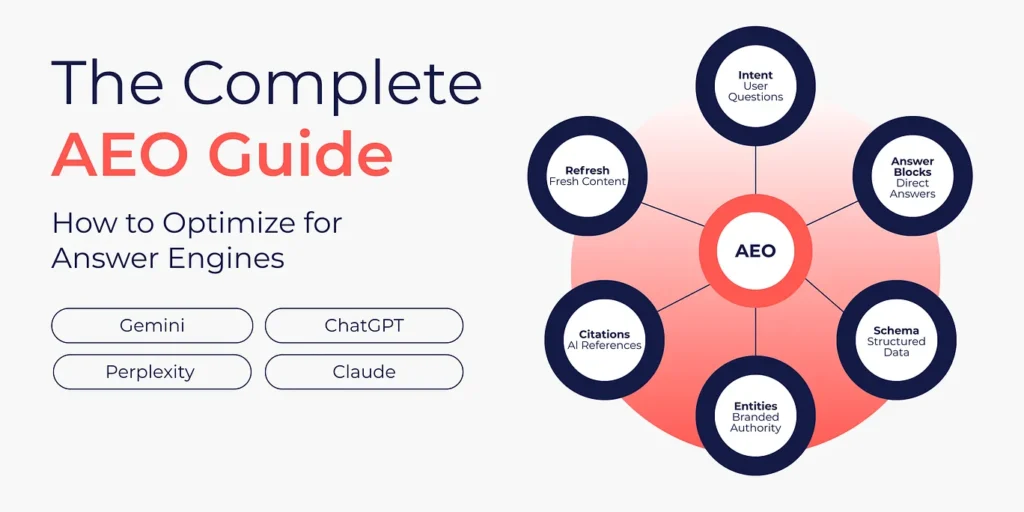
If you have been watching your organic traffic flatten while your content stays technically sound, the shift is not accidental. Search is being restructured around a fundamentally different paradigm, and the businesses that recognize this early are the ones building visibility that survives it. Answer engine optimization (AEO) is the discipline at the center of that shift, and this is the most complete guide to answer engine optimization available in 2026. It covers AEO from first principles to tactical implementation for 2026 and beyond.
What Is AEO and Why Does It Matter Now
Answer engine optimization is the practice of structuring your content so that AI-powered platforms select it as the direct answer to user questions rather than simply surfacing it as a ranked link in search engine results pages.
Traditional SEO is built around ranking. The goal is to appear in the top positions on search engine results pages so that users click through to your site. AEO operates on a different logic entirely. The goal is to be the source that the AI cites, quotes, or extracts when generating its response. The user may never click through to your site at all. The answer engines, including Google’s AI Overviews, ChatGPT, Perplexity, and voice assistants like Siri and Alexa, synthesize responses from across the web and present a single, direct answer. If your content is structured correctly and positioned as a trusted source, you become part of that answer.
The rise of zero-click searches is what makes AEO urgent. A user types or speaks a question. An AI model delivers a concise answer. The session ends. No click, no session recorded, no conversion attributed to your page, but your brand was the source. That is the new visibility metric, and it is growing in significance with every platform update.

AEO vs. Traditional SEO: A Clear Breakdown
Understanding answer engine optimization requires understanding where it departs from what you already know about traditional SEO. The two disciplines share some foundations but diverge significantly in goal, format, and success measurement.
| Dimension | Traditional SEO | Answer Engine Optimization (AEO) |
|---|---|---|
| Primary goal | SERP rankings and organic traffic | AI citation and brand mentions in answers |
| Success metric | Clicks, keyword rankings, impressions | Featured snippets, AI responses, citations |
| Query style | Keyword-based searches | Conversational, natural language processing |
| Content format | Keyword-optimized long-form pages | Concise, structured direct answers |
| Links matter for | Page rank and domain authority | External validation and grounding signals |
| Freshness factor | Important for time-sensitive queries | Critical; AI models prefer recent, accurate content |
| User intent focus | Matching intent categories | Answering the specific question being asked |
The most important distinction is this: traditional SEO asks, “How do I rank for this keyword?” while AEO asks, “How do I become the trusted source that AI engines rely on to answer this question?” Both matter in 2026. They are not competing strategies. But if you are only investing in traditional SEO and ignoring answer engine optimization, you are losing ground in the fastest-growing search surface right now.

How AI-Driven Search Experiences Work
To optimize for answer engines, you need to understand what is actually happening behind the scenes when a user gets a direct answer from an AI system.
Google’s AI Overviews (formerly the Search Generative Experience or SGE) uses a combination of Google’s knowledge graph, indexed content, and large language models to generate synthesized answers at the top of the results page. The sources it cites are selected based on authority signals, content clarity, entity recognition, and structured data signals.
ChatGPT retrieves and synthesizes information using its training data combined with real-time web browsing capabilities in its current versions. Content that appears on authoritative, well-structured domains with clear, direct answers to common questions has a higher likelihood of being retrieved and cited.
Perplexity is built entirely around answer generation with transparent citations. It actively browses the web in real time and surfaces the most clearly organized, factually grounded content it can find in response to user queries.
Voice assistants including Siri, Alexa, and Google Assistant compress the answer further. They return a single spoken response based on what the AI models determine is the most authoritative, concise, and contextually relevant result. For these surfaces, the content format matters enormously since there is no visual component and the user hears only one answer.
What all these systems share is dependence on natural language processing and machine learning to interpret user intent, identify the most relevant source, and extract the most useful answer from it. Your job in AEO is to make that extraction as easy and reliable as possible.
The Shift From Rankings to Citations
Here is the central reality of answer engine optimization in 2026: visibility is no longer purely a function of where you rank. It is a function of whether you are cited.
A page that ranks third on a traditional results page and never gets cited in an AI overview is losing ground to a page that ranks sixth but gets pulled into every AI response on that topic. Brand mentions in AI responses are becoming a proxy for authority in the same way that backlinks served as a proxy for authority in traditional SEO. The more consistently your business information, your content, and your expert perspectives are cited across AI results, the more your brand becomes part of the trusted source layer that these models draw from.
This has direct implications for how businesses need to think about their content strategy. Creating content designed purely for keyword rankings without considering whether an AI model can extract a clean, direct answer from it is an increasingly incomplete approach. The question is no longer just “Does this page rank?” but “When someone asks an AI this question, am I the source it reaches for?”
For businesses looking to build this kind of AI-era authority, Sublime SEO’s SEO Content Writing Services are built around exactly this kind of structured, intent-driven content creation that serves both traditional rankings and AI citation simultaneously.

User Intent and Content Format in AEO
AEO focuses on user intent more precisely than traditional keyword optimization does. People search differently when they expect an AI to answer. They use full questions, natural conversational phrasing, and often specify context that keyword-based searches strip out.
Understanding this changes how you approach content structure. For answer engine optimization to work, each piece of content needs to anticipate the specific questions users are asking and deliver clear answers at the point in the content where the AI model will look for them. This means:
- Opening each section with a direct answer, followed by supporting context rather than burying the answer after a preamble
- Using question-based headings that directly mirror how users phrase their queries in natural language
- Structuring information in bullet points where lists naturally organize the answer rather than forcing it into dense paragraphs
- Keeping answer units concise at 40 to 60 words per direct response, even within a longer piece of content
- Separating factual claims from analysis so that AI models can extract facts cleanly without having to parse through editorial commentary
The content format itself is a signal. AI models trained on vast amounts of structured human communication learn to identify well-organized, clearly presented, factually grounded responses and weight them above dense, keyword-heavy prose that lacks a clear answer structure.
Sublime SEO’s On-Page SEO Services include full content restructuring to ensure every page is formatted for both search engine results pages and AI response extraction.
Schema Markup: The Technical Foundation of AEO
If user intent and content format are the strategic layer of answer engine optimization, schema markup is the technical layer. Structured data tells AI models and search engines not just what your content says, but what it means.
Schema markup is code added to your page in JSON-LD format that creates machine-readable context around your content. Where a human reader understands that a block of text is a FAQ, a structured data implementation makes that explicit to AI systems, which can then extract and use individual question-answer pairs as discrete answer units.
The Three-Layer Schema Model for AEO
Layer 1 — Sitewide Identity
Your homepage and core site templates should carry Organization schema that defines who you are: legal name, URL, logo, contact points, social profiles, and any relevant identifiers. This anchor layer helps AI models attribute content correctly and connect your brand mentions across the web.
Layer 2 — Page Context
Every indexed page should declare itself as a WebPage entity. Add BreadcrumbList markup to show content hierarchy and use mainEntity, about, or mentions properties to indicate what each page is about. This helps AI models cluster related content correctly and understand your site’s topical authority.
Layer 3 — Content Type
When a page contains a specific content type, implement the appropriate schema. Use Article for blog posts, FAQPage for FAQ content, HowTo for step-by-step guides, Service for service pages, LocalBusiness for location-based pages, and Product for e-commerce. Each type signals to AI models how to process and potentially extract the content.
Schema Types That Matter Most for AEO
| Schema Type | Use Case | AEO Benefit |
|---|---|---|
| FAQPage | Pages with Q&A sections | Directly feeds AI question-answer extraction |
| HowTo | Instructional content | Used in AI step-by-step response generation |
| Article | Blog posts and guides | Establishes authorship and content freshness |
| LocalBusiness | Location-specific pages | Powers voice search local responses |
| Organization | Homepage and sitewide | Anchors entity identity across all AI surfaces |
| Speakable | Text suitable for voice | Signals audio-extractable content to voice assistants |
The key principle is this: structured data does not rank pages. It disambiguates them. It tells AI models with clarity and authority that your organization is the specific entity being referenced, that your content is the specific answer to this specific question, and that the source is reliable and verifiable.
Sublime SEO’s Technical SEO Services include full schema implementation, structured data auditing, and ongoing validation to ensure your site’s markup is both correct and competitive.
Building a Dedicated FAQ Section for AEO
A dedicated FAQ section is one of the highest-leverage tactical investments you can make for answer engine optimization. Every question-answer pair you create is a potential extraction point for AI responses, a potential featured snippet in traditional search engine results pages, and a signal to voice assistants that your content is built to answer questions directly.
The most effective FAQ sections for AEO share these characteristics:
- Questions match real user phrasing. Use the actual language people search for, not the language your business prefers. Tools like Google’s People Also Ask, Answer the Public, and search autocomplete data reveal how users actually phrase their queries.
- Answers are self-contained. Each answer should make complete sense without the context of the surrounding page. AI models extract answers as standalone units, and an answer that depends on prior context on the page will either be extracted incompletely or skipped.
- FAQPage schema is implemented correctly. The schema should match the visible on-page content exactly. Implementing schema for FAQ content that is not visible on the page is a guideline violation.
- Questions cover the full intent spectrum. Include definitional questions (what is), comparative questions (AEO vs. SEO), procedural questions (how to), and evaluative questions (is X worth doing). This breadth ensures you are covering the range of query types AI models receive.

AEO Tactical Implementation: Step by Step
Here is the complete implementation roadmap for answer engine optimization in 2026:
Step 1: Audit Your Content for AI Extractability
Review your existing pages through the lens of an AI model trying to extract a clean answer. For each major page, ask: is there a clear, direct answer within the first 100 words of any section? Are headings structured as questions or clear declarative statements? Is the information organized in a way that a model can parse without ambiguity? Flag every page that fails these tests as a restructuring priority.
Step 2: Map User Intent Across Your Content Inventory
For each service area, product category, or topic cluster, build a map of every question a user might ask and where in your content that question is currently answered or not answered. This intent map becomes your content creation and restructuring roadmap. Gaps in coverage are gaps in AI citation opportunity.
Step 3: Implement Structured Data at Scale
Do not hand-code schema on individual pages. Embed JSON-LD into your CMS templates so that Organization, WebPage, and content-type schema deploys automatically at scale. Use Google’s Rich Results Test to validate, and monitor Google Search Console for structured data errors monthly.
Step 4: Build a Dedicated FAQ Section on Every Major Service Page
Every service page, product page, and pillar content piece should include a dedicated FAQ section with a minimum of five to eight question-answer pairs covering the most common queries related to that topic. Implement FAQPage schema on each. This creates multiple AI extraction points per page rather than one.
Step 5: Optimize for Voice Search Query Formats
Voice assistants return one answer. That answer comes from content that is phrased conversationally, answers a complete question, and is structured in a way that reads naturally when spoken aloud. Create Speakable schema for sections of content specifically designed for voice extraction. Keep those passages to 20 to 30 seconds of spoken content, approximately 50 to 70 words.
Step 6: Broaden Your Entity Footprint Beyond Google
AI models draw from multiple data sources to build their understanding of who you are and whether to trust your content. Your business info needs to be consistent and present across your Google Business Profile, Bing Places, Apple Maps, Yelp, industry directories, Wikipedia (where eligible), and relevant social profiles. Entity consistency across all these surfaces is one of the most underutilized AEO signals in practice.
Step 7: Earn Brand Mentions Across Trusted Sources
AI models weight sources that are referenced and validated by other trusted sources. Earning brand mentions in industry publications, news sites, authoritative blogs, and third-party review platforms is the off-page AEO equivalent of link building. You are not just building authority for ranking. You are building the web of corroborating signals that AI models use to confirm your trustworthiness as a source.
Step 8: Create and Maintain a Consistent Content Freshness Cadence
AI models, particularly Perplexity and ChatGPT with web browsing enabled, strongly prefer recent content. A piece published in 2019 and never updated competes poorly against a piece updated in the last 90 days when the query has any time-sensitive dimension. Establish a content refresh schedule for your highest-traffic pages and highest-priority topic areas.
AEO for Local Businesses
For local businesses, AEO has a specific and immediate application in voice search. When a user asks a voice assistant a question like “who is the best accountant near me” or “what are the opening hours for [business name],” the AI model draws from a combination of your structured data, your Google Business Profile, and corroborating mentions across third-party platforms to generate its spoken response.
This means local businesses need to treat their entire digital presence as an entity network, not just a website. Your address, phone number, hours, service descriptions, and reviews need to be consistent across every platform your business appears on. A discrepancy between your website and your Google Business Profile is not just a local SEO issue. It is an AEO signal problem that directly reduces the confidence AI models place in your business information when generating local answers.
For businesses in competitive local markets, the combination of Local SEO Solutions and structured AEO implementation creates a compounding visibility advantage across both traditional search engine results pages and AI-driven voice responses.
AEO for E-Commerce and Product Pages
E-commerce businesses face a distinct AEO challenge. Product pages need to answer not just “what is this product” but the full range of purchase-intent questions: how does it compare to alternatives, what are the specifications, what do customers say, what is the return policy, and who is this right for.
AI models increasingly surface product information directly in response to shopping queries. Product schema, Review schema, and FAQ schema on product and category pages are the structured data priorities here. The goal is to make every major product query answerable directly from your page without the user needing to navigate your site or visit a competitor to get the information they need to make a decision.
For Shopify merchants in particular, schema implementation at the template level is critical because Shopify’s default schema output is incomplete for AEO purposes.
Sublime SEO’s SEO Services for Shopify include custom schema development that goes beyond Shopify’s native structured data to build a complete AEO-ready product entity layer.
How to Measure AEO Success
The metrics for answer engine optimization are still evolving, but here is the measurement framework that reflects current best practice:
- Featured snippet acquisition rate. Track the number and percentage of your target queries where your content appears in a featured snippet on traditional search engine results pages. Featured snippets are the closest traditional SEO proxy for AEO performance.
- AI Overview citations. Use manual query testing or emerging AI visibility tools to track how frequently your brand and content are cited in Google’s AI Overviews for your priority topics. Tools like SE Ranking’s AI Overviews tracking module are beginning to formalize this measurement.
- Brand mention monitoring. Track brand mentions across the web using tools like Mention, Brand24, or Google Alerts. Growing brand mention volume across authoritative domains is the off-page AEO signal that correlates with growing AI citation frequency.
- Voice search testing. Manually test priority queries through voice assistants and document which sources are cited. This is low-tech but highly informative about whether your AEO implementation is producing results on voice surfaces.
- Zero-click search trends. Monitor your organic click-through rate over time. A declining CTR alongside stable or growing impressions is often a signal that your content is being extracted and used in AI responses without generating clicks. This is not necessarily bad. It means your content is being cited. Track branded search volume alongside this metric to confirm whether overall brand awareness is growing.
Common AEO Mistakes to Avoid
❌ Optimizing for keywords without optimizing for questions. Keywords are inputs to search engines. Questions are inputs to answer engines. A page built around “best SEO services” performs differently from a page built around “what are the best SEO services for a small business and why.” Structure content for the question, not just the keyword.
❌ Implementing schema without matching visible content. Schema that describes content not present on the page is a guideline violation and can result in manual penalties. Every structured data property must correspond to something a user can actually see on the page.
❌ Neglecting entity consistency. If your business name appears as “Sublime SEO” on your website, “Sublime SEO Inc.” on your directory listing, and “SublimeSEO” on your social profile, AI models see three potentially different entities. This fragmentation reduces the trust signals that anchor your brand in the AI knowledge layer.
❌ Writing for density rather than clarity. Long-form content that buries its answers in paragraphs of context is designed for human reading habits, not AI extraction. AEO content leads with the answer and supports it with context, not the reverse.
❌ Ignoring voice search formatting. Text that reads well on screen does not always translate to a natural spoken response. Content intended for voice extraction needs to be tested aurally, not just visually.
How Sublime SEO Implements AEO for Clients
Answer engine optimization is not a single service or a single deliverable. It is an integrated approach that runs across content strategy, on-page structure, technical implementation, link and entity building, and ongoing measurement. Every service Sublime SEO offers has been updated to account for the AI-driven search landscape that is defining search in 2026.
Did you enjoy our guide to answer engine optimization? Are you ready to position your brand at the front of the AI search era? The shift from rankings to citations is already underway, and the businesses investing in answer engine optimization now are building the authority signals that will define their visibility for the next three to five years.
Get in touch with Sublime SEO and let us build your AEO strategy from the ground up.
Frequently Asked Questions
Answer engine optimization is the practice of structuring content so that AI-powered platforms, including Google’s AI Overviews, ChatGPT, and Perplexity, select it as the direct answer to user questions rather than simply ranking it as a link in search results.
Traditional SEO focuses on ranking in search engine results pages and driving organic traffic through clicks. AEO focuses on being cited by AI models as the source of a direct answer. Success in traditional SEO is measured in rankings and clicks. Success in AEO is measured in citations, featured snippets, and brand mentions in AI responses.
No. The structural improvements that answer engine optimization requires, including clearer headings, more direct answers, better FAQ sections, and stronger schema markup, also improve traditional SEO performance. The two disciplines are largely complementary.
Schema markup is structured data code added to your pages that gives AI models and search engines explicit, machine-readable context about your content. For AEO, it is the technical foundation that allows AI systems to correctly identify your content as the answer to specific question types.
The primary surfaces in 2026 are Google’s AI Overviews, ChatGPT (with browsing), Perplexity, and voice assistants including Google Assistant, Siri, and Alexa. Each has slightly different content preferences, but the core AEO principles of clear answers, structured content, and entity authority apply across all of them.
Track featured snippet acquisition, Google AI Overview citation frequency using manual testing and dedicated AI visibility tools, branded search volume growth, and voice search response audits. Declining click-through rate alongside stable or growing impressions can also indicate that your content is being extracted for AI responses.
Not necessarily all of it. Start by auditing your highest-traffic pages and your priority service or product pages. Restructure these first for direct answer formatting, add FAQ sections with FAQPage schema, and update the schema implementation sitewide. Then expand to the rest of your content inventory systematically.
Extremely important. AI models aggregate business information from multiple sources to form a trusted entity profile. Inconsistencies in your name, address, phone number, and hours across platforms reduce the confidence AI models place in your data and make it less likely your business info is used in local voice search responses.
No. In fact, small and mid-size businesses often have an advantage in niche topic areas where less competition for AI citations exists. Focused AEO implementation in a specific industry vertical can produce significant visibility gains faster than trying to compete broadly.
The fastest starting point is a content audit for AI extractability, followed by schema implementation on your highest-priority pages, and then a dedicated FAQ section build. For businesses that want a fully managed approach, Sublime SEO’s complete AEO service stack covers every layer of implementation from technical to content to entity building.