The AI Optimization Checklist: Technical Fixes That Matter Now
According to a 2025 Bain & Company study, roughly 60% of searches now end with zero clicks. Users get their answer directly from an AI summary and never visit a single website.
If your site is built only for traditional search engines, you are already behind. AI optimization is now part of modern SEO because AI systems and answer engines are shaping how content is discovered, summarized, and surfaced in search results.
At Sublime SEO, we work with clients across a variety of industries and the pattern we keep seeing is the same: strong rankings, but shrinking traffic. For brands, that means visibility is about more than just rankings. It is also about whether your pages are easy for AI models to understand, trust, and quote. This checklist gives you a fast, practical way to improve AI visibility without turning your site into jargon-heavy content.
What AI Optimization Actually Means
AI optimization is the process of making your content easier for both traditional search engines and AI systems to understand. It overlaps with search engine optimization, but it also needs to account for how AI models interpret structure, entities, and direct answers. In simple terms, good AI engine optimization helps your content become easier to find, easier to summarize, and easier to trust.
AI Search vs Traditional Search
The goal is not to replace SEO. The goal is to make your SEO stronger in an environment where AI visibility matters.
Why AI Visibility Matters Now
We have noticed this shift accelerating with our own clients over the past twelve months. People are seeing AI overviews, search results, and AI-generated answers before they click a traditional result. That changes how discovery works and shifts attention away from standard listings. It also affects website traffic, referral traffic, and brand discovery. If your content is not built for AI visibility, you may still rank, but you may not be featured in AI-generated responses or summary layers.
Sublime SEO’s On-Page SEO Services include full content restructuring to ensure every page is formatted for both search engine results pages and AI response extraction.

The Core AI SEO Optimization Checklist
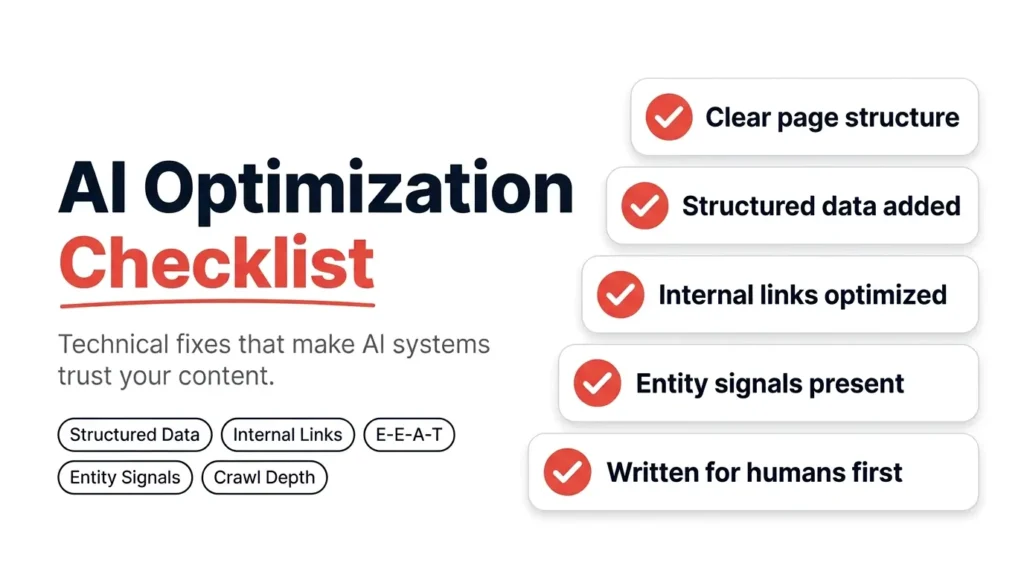
Use this AI SEO optimization checklist as the foundation for every important page on your site:
- Make the page topic obvious in the first paragraph.
- Use one clear H1.
- Use structured H2s that follow a logical path.
- Add structured data where it fits.
- Improve crawl depth with internal links.
- Write for a human reader first.
- Make each section answer one clear question.
- Keep the page focused on one primary intent.
This is the practical side of AI optimization. You are not trying to game AI systems. You are making your site easier to understand, easier to trust, and easier to use in AI-generated answers.

Start With Structured Data and Entity Signals
Structured data helps search engines and AI models identify what a page is about. It gives context around the topic, the organization behind it, and the relationships between entities.

Strong entity signals help too. Mention the people, services, industries, and concepts connected to the topic in a natural way. When the page clearly reinforces who you are and what you do, AI systems have less room to misread it.
When we audit client sites, missing or incomplete structured data is one of the first things we flag and it is almost always a quick win.
Allow AI Bots to Crawl Your Site
Strong entity signals help too. Mention the people, services, industries, and concepts connected to the topic in a natural way. When the page clearly reinforces who you are and what you do, AI systems have less room to misread it.
When we audit client sites, missing or incomplete structured data is one of the first things we flag and it is almost always a quick win.
Fix Crawl Depth and Internal Linking
A page that sits too deep in the site architecture is harder to discover and harder to trust. Internal links help search engines and AI systems move through the site and understand which pages matter most.
Here is the basic rule:
- Link from supporting articles to service pages.
- Link between related articles.
- Link from high-authority pages to important money pages.
- Make important pages reachable in a few clicks.
- Use anchor text that describes the destination clearly.
- A shallow, well-linked site supports both traditional SEO and AI engine optimization.

Structure Content for Human Readers and AI Systems
Good AI optimization starts with good writing. The page should match user intent, use a clear structure, and avoid vague language.
Use short paragraphs, direct language, and answer the main question early. Keep the brand voice consistent. If a human reader can scan the page quickly, AI systems usually can too.
For businesses looking to build this kind of AI-era authority, Sublime SEO’s SEO Content Writing Services are built around exactly this kind of structure, intent-driven content creation that serves both traditional rankings and AI citation simultaneously.
Strengthen E-E-A-T and Topical Authority
AI systems are more likely to surface content that looks credible, specific, and grounded in real expertise. That is where E-E-A-T matters.
Show who wrote the page, why they are qualified, and how the content connects to a broader content strategy. A cluster of connected web pages sends a stronger signal than one isolated article. We consistently see clients with strong topical clusters outperform larger sites that publish isolated, disconnected content.
Build Presence Beyond Your Own Site
AI systems do not only pull from your website. They also reference third-party sources such as industry publications, review platforms, directories, forums, and podcast transcripts. If your brand is not mentioned in trusted places outside your domain, AI has less reason to include you in its responses. Guest articles, updated directory listings, and consistent expert contributions across authoritative platforms all reinforce your credibility as a source worth citing.
Common AI Engine Optimization Mistakes
The most common mistakes are usually simple:
- Thin pages with little substance.
- Weak internal linking.
- Vague headings.
- Overused keywords without new value.
- Content written to impress algorithms instead of help readers.
- Pages that do not answer the user’s intent quickly.
If the content feels shallow or generic, both human readers and AI systems are less likely to trust it.

A Fast Audit You Can Run Today
Run this quick audit on any page you want to improve:
- Is the topic obvious within the first paragraph?
- Does the H1 clearly match the page intent?
- Are headings structured logically?
- Does the page include structured data where relevant?
- Are internal links pointing to important key pages?
- Is the writing clear enough for a human reader to scan quickly?
- Would this page still make sense if it appeared in an AI summary?
If the answer is no to more than two of these, the page likely needs work.
Good vs Weak AI Optimization
Use this table as a quick editorial filter before publishing.

Final takeaway
AI optimization is not about chasing every new platform. It is about making your site easier to understand, easier to trust, and easier to surface in AI-powered search.
Everything on this checklist comes from work we do with real clients and the results we see most often come from the basics done well: structure, clarity, internal links, and entity signals. Start there, and keep building from that foundation.
Want an AI Optimization Audit?
At Sublime SEO we can review your schema, internal linking, content structure, and entity signals to find quick wins for AI visibility.
Frequently Asked Questions
Results depend on the site, but technical fixes like structured data, internal links, and clearer headings can help faster than larger content changes.
Start with your most important service pages, high-traffic educational content, and pages that answer common customer questions.
The biggest mistake is treating AI engine optimization like keyword stuffing instead of improving structure, clarity, and context.
No. Traditional SEO still matters, but AI overviews add another visibility layer that content now needs to support.
Look for signs like branded mentions in AI responses, inclusion in summaries, referral traffic from AI tools, and improved visibility for key pages.